
Q&A with David: Running Because I Can

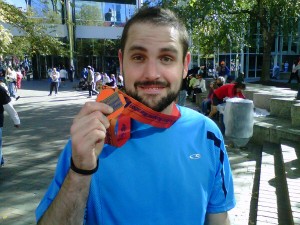
David is a runner and a father from Bedford, Virginia. You probably already know him from his excellent running blog, Running Because I Can, and as the cohost of #runchat on Twitter. He’s been running for a few years longer than I have, but similar to me, he’s pretty recently gotten over a nasty ITB injury. While I wouldn’t wish an injury like that on anyone, it was nice to have someone else to kind of go through that experience with, since we were both in much the same place physically and mentally.

Recently, David asked me to do a Q&A on his site, and we thought it would be fun to post Q&A’s with each other on the same day, so head on over to David’s blog to check out his Q&A with me!

How long have you been running, and what got you started?
It all started with a photo my wife took of me at Crabtree Falls in Nelson County, Va., during a hike on Jan. 1, 2004. That same day we bought a scale and to my surprise I weighed 220 pounds. I always thought I was “around” 200, but hadn’t weighed myself in a few years. I started a route by just walking and doing a little running, going a little farther each day. It took me about a month to run this whole route. I haven’t stopped much since then. That all being said, I actually ran track in high school in the mid-1990s. I was usually a next-to-last type finisher, but I still managed to log a sub-6 minute mile in a race.

What do you like most about running?
Tough question that often depends on the day of the week. I like the “me” time. I like that feeling of getting away from everything several times a week to clear my head.

What is the most important lesson this injury has taught you?
That the “other” things truly matter. This is actually my second ITB injury (right side first time around), but I got over the first one fairly easily for whatever reason, which didn’t give me a chance to learn anything. (I’ve also had plantar faciitis.) This time around, though, I’ve taken the time to research what can cause ITBS (there’s no clear-cut No. 1 answer out there) and gone to a chiropractor. The answers I got were right there in front of me the whole time, and I knew that, but didn’t do anything: core work. Core work (which is more than just sit-ups) is key to everything else in the body lining up and giving you the strength to not get so sloppy in a run. For the first time since I first lost weight, I’m finally consistent with doing a wide variety of sit-ups, doing push-ups a few times a week, squats, using the Bosu ball for workouts and more. Those “other” things will forever be a part of my training now.

What is your “dream race” that you’d like to run some day?
I’m not a big “destination” race type of person, but I do want to use bigger races as a way to visit more places down the road. This year, for example, I (spontaneously) signed up for the Baltimore Marathon, which will turn into a mini-vacation. I’m more of a fan of tradition, so I’m looking forward to getting back to Virginia Beach next March for my fifth Shamrock Half Marathon. I missed it this year due to my recovery and it felt like having to spend a day at a car shop on my birthday.

What is the one piece of running gear you can’t live without?
I can live with just about anything. I never feel like I “need” things, like my Garmin. When it comes to gear or what I’m wearing, the thing(s) I want to be most comfortable are my feet. Good shoes are a must. And I recently discovered the awesomeness of toe socks, so I’ve become a huge fan of Injinji and ToeSox.

Where do you fall in the eternal debate over listening to music while running?
To me, it’s not a debate. I think people should do whatever is comfortable for them, but be respectful and smart about it. When it comes to a race, if people have headphones on, they better be sure they have the volume low enough to hear what’s going on around them. Having been in a race in which I saw a person getting CPR after collapsing and then dying, my eyes have been opened to how important it is to know what your surroundings are in a race, especially for the majority of us who have no chance of winning. I never listen to music in a race; on my runs, I’ll listen to music on my long runs, but that’s about it.

As a family man, how do you balance family time with running and training?
Family always comes first. Nothing is more important. My son goes to bed by 8 p.m., so I tend to use the time after that to workout. On weekends, I just get up early and head out the door. I eventually will be a morning runner all the time. (If I keep saying it, I know it will happen eventually.) In the first two and a half years, it hasn’t been all that hard. I did initially gain some weight back when he was born after getting sleep deprived and lazy, but I got that back on track.

What kind of an impact has social media (dailymile, Twitter, blogs, etc.) had on your running?
Joining Daily Mile last year was the second best social media decision ever – the first was starting my blog 4 years ago this month. A couple of people had pushed me to Daily Mile for a while, but I was reluctant. The support on there, though, amazed me. It has totally changed the way I look at logging my workouts, giving a story behind most run or workout. It makes me think about how I feel. I’ve been able to connect with so many like-minded people, gotten advice from people way more experienced than me and helped others come along. Twitter has been great, especially after Scott from iRunnerBlog.com and I launched #runchat last June. I’ve connected with a lot of runners via that chat and love seeing people use the #runchat tag throughout the week.

Getting past your love of running, what’s something many people might not know about you?
I’m a NASCAR fan. I’ve been to a few races (Daytona in July, Martinsville a couple of times, Richmond) and even managed a fantasy league with a few friends for a few years. While my interest isn’t quite what it used to be, I still catch portions of every race.

In addition to his running blog, David can be found online on Twitter and dailymile.
Watchless Monday

The idea for “watchless Monday” came up a few days ago on Twitter when David (@runningbecause) started talking about going on a run just for the sheer joy of running. No GPS, no watch, just you and the road. So simple. And yet many of us get so caught up with our training, and worrying about pace and distance and time, that we don’t do it as often as we probably should.

Pretty quickly, several of us (myself, @262milejourney, and @suzistorm) chimed in that we need to go watchless more often, and just enjoy our runs. And thus watchless Monday was born. The idea is simple: on your first run each week (it doesn’t necessarily have to be Monday), commit to going watchless. For at least that one run per week, don’t worry about your pace or your time. Just run and enjoy yourself.

While it’s not a requirement for watchless Monday, I’m going to take it one step farther myself, and run completely “naked”, meaning no watch, no GPS, no music. I don’t always listen to music on my runs anyways, but I’m going to at least commit myself to going without once per week.

Will you join us? We’ll be using the #watchlessmonday tag on Twitter to chat about our watchless runs, so you can follow along and join us. We hope to see you there!

My Training Plan, or Lack Thereof

When training for a marathon, or any other type of race, the training plan you follow is a very personal subject. Some will swear by Hal Higdon’s training plans, others like Smart Coach from Runner’s World, while others don’t follow a training plan at all, and pretty much just wing it. I find myself somewhere in the middle, though I tend to lean more toward the non-planners.

For me, running is a joy. It’s my time to unwind and just be with me and my thoughts. I fear that taking on a more structured training plan would turn running into something more like a job, and zap much of the enjoyment out of it for me. I see lots of people on Twitter and dailymile writing things like “I have to run 16 miles today”, or “I have to run hill repeats today”. I don’t want to ever feel like I have to run anything. I want to go for a run because I want to, not because I feel like I have to, and feel upset or frustrated with myself if I don’t.

All that being said, I do recognize the value of a long run, especially when training for a marathon. So the one part of my training that does get at least some planning are my long runs. But other than that, I pretty much wing it. On any particular day that I go for a run, there is very little pre-planning that goes into it. If I feel like doing speed work, I do that. If I feel like doing hill repeats, I do that. If I feel like taking it easy and going slow, I do that. When I’m heading out the door, I have a general idea of the mileage I’m shooting for, and I pick a route that gets me close to that.

This isn’t to say that I don’t do any planning. One of the most important lessons I learned from my recent injury was to respect the 10% rule. So for this round of training, I created a spreadsheet where I fill in each week’s mileage, and then it automatically calculates +10% for me for the following week. From there I work backwards to get a basic plan for my runs for the week. I pretty much have all my long runs mapped out, so I can punch that number in for the week, and see how much remaining mileage I have to work with.

Perhaps, somewhere down the road, a day will come when I decide I’d like to do something crazy, like qualify for Boston. At that point, I’ll obviously have to take my training up a couple of notches. Until then, my non-plan suits me just fine.

Lessons Learned From Being Injured

I’ve had enough time now with some really good runs, and no more nagging pain from my knee/IT band, that I finally feel safe in declaring “I’m back!” This injury put me out of commission for a good 6-8 weeks, and let me tell you, that wasn’t fun at all.

Along the way, I’ve learned a few lessons that I hope will not only help me to be a stronger – and smarter – runner going forward, I hope that I can help you avoid some of the same mistakes that I made. Some are things that contributed to my injury in the first place, others likely prolonged the injury longer that it needed to be.

  • Don’t be a one-dimensional athlete. Cross-training is your friend. These past few weeks and months, I’ve been incorporating much more time on the bike into my routine, as well strength training and core exercises.
  • Respect the 10% rule. An oft-quoted rule of thumb for runners to avoid injury is to not increase your mileage by more than 10% from one week to the next. When I was training for my first marathon during the last few months of last year, I’m sure I violated this rule many times. I was pretty much just running as much as I could reasonably fit into my schedule. I didn’t upgrade from the half marathon to the full marathon until only about 8 weeks out, so I was on a relatively condensed training cycle, and I wanted to get in as many miles as I could before the big day. I’m currently training for my 2nd marathon in June, and this time around, I’m being much more mindful of my weekly mileage.
  • Avoid the “terrible too’s”. This is pretty directly related to the last point. Most running injuries are a result of overtraining: too much, too soon, too often, too fast, too hard, with too little rest.
  • Become one with your foam roller. I know the foam roller isn’t for everybody, but it worked wonders for me. If it hurts, you know it’s working. It just tells you how much you needed it.
  • 3 words: stretching, stretching, stretching. Ok, maybe that was just one word, repeated 3 times. So sue me. I repeated it 3 times because it’s important. There is a lot of debate about whether you should stretch before a run. The argument is that stretching cold muscles can actually do more harm than good. I tend to agree here. What I usually do instead is force myself to walk at a brisk pace for about 5 minutes before starting my run, and to then start my run off at a relatively slow pace for about the first 5 minutes. Then, when I get back from my run, I’ll do some “traditional” stretching.
  • Denial ain’t just a river in Egypt. If you’re injured, fess up to it. Don’t lie to yourself. Beth from Shut Up and Run recently wrote a great post about how the injury process very closely follows the 5 stages of grief. Step #1 is denial, where you don’t want to accept the fact that you’re injured. I know I went through all these stages myself, including anger, and even a bit of depression. The quicker you can recognize that your injured and learn to accept it, the quicker you’ll be on the road to recovery.
  • If you suspect an injury, go see a physical therapist. I’m going to fess up and tell you that I never saw a physical therapist during this whole process, so this is more of a do as I say, not as I do kind of thing. Yes, I’m one of those hard-headed kind of guys that doesn’t like to go to the doctor unless a limb is falling off. I need to work on that, I know. But if you suspect an injury, I’d highly recommend getting yourself checked out. They should be able to accurately diagnose your injury, and get you doing some stretches and/or strengthening exercises to quickly get you on the road to recovery. And unless you’ve got a serious injury like a stress fracture, most physical therapists won’t tell you to stop running (at least not completely). As I heard recently on Dirt Dawg’s podcast “runners don’t  stop running, they just stop going to therapy.”

One final point I’ll make is to never take for granted your ability to run. Running is a gift, and it’s important to remember that it can be taken from you at any time. Cherish every moment.

It’s My Runiversary!

One year ago today, I stepped out my front door and completed my first day of Couch to 5k. Little did I know at the time, but that day I was beginning a journey that would ignite a passion in me and change my life forever.

If you haven’t caught on by now, I have fallen head-over-heels in love with running. In a relatively short time, it has become a great passion of mine and one of my main focuses – after my family, of course! Before that fateful day one year ago, I had never run before in my life – or at least not running just for the sake of running. I played football and basketball in high school, which obviously involved plenty of running. And I suppose there were those times back in school where you had to run a mile in gym. But aside from that, I had never woken up thinking “I’d like to go for a run today”.

When I went out for that first run, I had no idea what I was getting myself into. I didn’t plan on falling in love with running. At the time, it just seemed like the thing to do. I was hoping it would help me continue to lose the extra weight I was trying to shed, and let me get in some good cardio time each week, but that was really about it. I can still remember how hard those first runs were. Running for only a minute or two at a time left my lungs feeling like they were on fire, desperately in search of more oxygen. Each week I slowly built up my endurance, until I could finally run for 20 minutes straight. At the time, those 20 minutes were huge, and I felt on top of the world. It wasn’t long after that when my real attraction for running began to form, and I could see myself wanting to continue doing this for more reasons that just trying to lose some weight.

Before I knew it, I had run my first 5k. Not long after that, I was running a half marathon, and then another. Finally, in December, just 8 months after that fateful day in April that started it all, I completed my first marathon.

And now here I am today, back into the swing of things after suffering what I’d call my first “major” running injury. I’ve got my 2nd marathon lined up in June, as well as a slew of other exciting races planned for this year.

When I first started running, it was just about losing weight and getting in shape. Now, I’d consider it an essential part of my physical and mental well-being. As the saying goes “running – it’s cheaper than therapy”. It seems that no matter how bad or a stressful of a day I’ve had, I can go out for a run and come back a new man, refreshed and rejuvenated. There’s something about the simplicity of just you and the road – or trail – that’s very zen-like. It’s peaceful, calming, and immensely therapeutic.

It’s been a great first year of running, and I’m really looking forward to seeing how my relationship with running grows and evolves in the (hopefully many) years to come.